
India skilled worker quota Czech Republic, Does Czechia Need a Higher Qualified Worker Quota for India’s Hospitality Sector?
Policy commentary · Information verified as of 8 September 2026 · Approximately 8 minutes reading

Executive summary
Czech restaurants continue to face high operating costs and shortages of experienced staff. Indian restaurants face an additional challenge: authentic cuisine often requires chefs and kitchen workers with specialised practical knowledge that is not readily available in the local labour market.
The Czech Embassy in New Delhi may accept 1,560 Employee Card applications annually, but only 600 places are allocated to the Qualified Worker Programme—the route most relevant to regular chefs, cooks and operational restaurant workers. The remaining 960 places are shared between the Highly Qualified Worker Programme and the Key and Research Staff Programme, which are intended for different categories of employees.
A gradual increase in the 600-place allocation could help eligible Czech employers recruit verified Indian workers under regulated conditions, support the development of Indian gastronomy and complement Czechia’s efforts to attract visitors from India. (India skilled orkerquota or Czech Republic)
The objective should not be access to inexpensive labour. It should be access to appropriately skilled workers receiving at least the legally required salary and fair remuneration reflecting their experience, responsibilities and working conditions.
Czech restaurants are under pressure
Czech gastronomy has experienced a succession of economic shocks. The pandemic was followed by Russia’s invasion of Ukraine, the European energy crisis, food inflation, higher commercial rents and continued staffing difficulties.
Restaurants are especially exposed to energy costs. Commercial kitchens depend on ovens, grills, fryers, refrigeration, ventilation, dishwashers, heating and lighting for many hours every day.
The Czech government introduced electricity and gas price caps during the energy crisis, but many businesses still paid substantially more than under their previous contracts. The International Energy Agency records the Czech measures adopted to support households and smaller businesses.
Food and transport became more expensive as well. Eurostat reported that prices for oils and fats across the EU were 23% higher in March 2023 than one year earlier. Eurostat
Official Czech statistics show that the average price of diesel increased from CZK 31.26 per litre in 2021 to CZK 43.42 in 2022. Higher fuel prices increased the cost of transporting food, beverages, equipment and imported ingredients. Czech Ministry of Industry and Trade
At the same time, restaurants could not pass every additional cost to their customers. Czech households were also facing higher prices for housing, groceries, transport and energy.
According to Expats.cz, the average restaurant lunch price in Czechia had risen by more than 60% since 2020, reaching CZK 194.20 in March 2025 and CZK 218 in Prague. The report identified operating costs, inflation, wage pressure and staffing shortages among the challenges facing the industry.
Why Indian restaurants need experienced workers
Indian cuisine requires more than a collection of standard recipes.
An experienced chef understands spice combinations, temperature control, marination, dough preparation, tandoor operation and the organisation of bulk cooking during busy service periods. Restaurants also need reliable cooks and kitchen workers who understand hygiene, preparation sequences, portion control and teamwork.
Such skills can be developed locally, and Czech and EU workers should continue to have fair access to available jobs. However, when employers cannot find candidates with the necessary experience, controlled recruitment from India is reasonable.
Without suitable employees, a restaurant may have sufficient investment and customer demand but remain unable to extend its opening hours, maintain consistent quality or open another branch.
The issue is therefore not about employing workers as cheaply as possible. It is about enabling compliant employers to recruit people with the right skills while providing lawful salaries and proper working conditions.
What the Embassy’s published figures actually show
The Czech Embassy in New Delhi publishes annual intake figures for different long-term visa and residence categories. These provide valuable context, but they cannot all be combined into a single “Indian worker quota.”
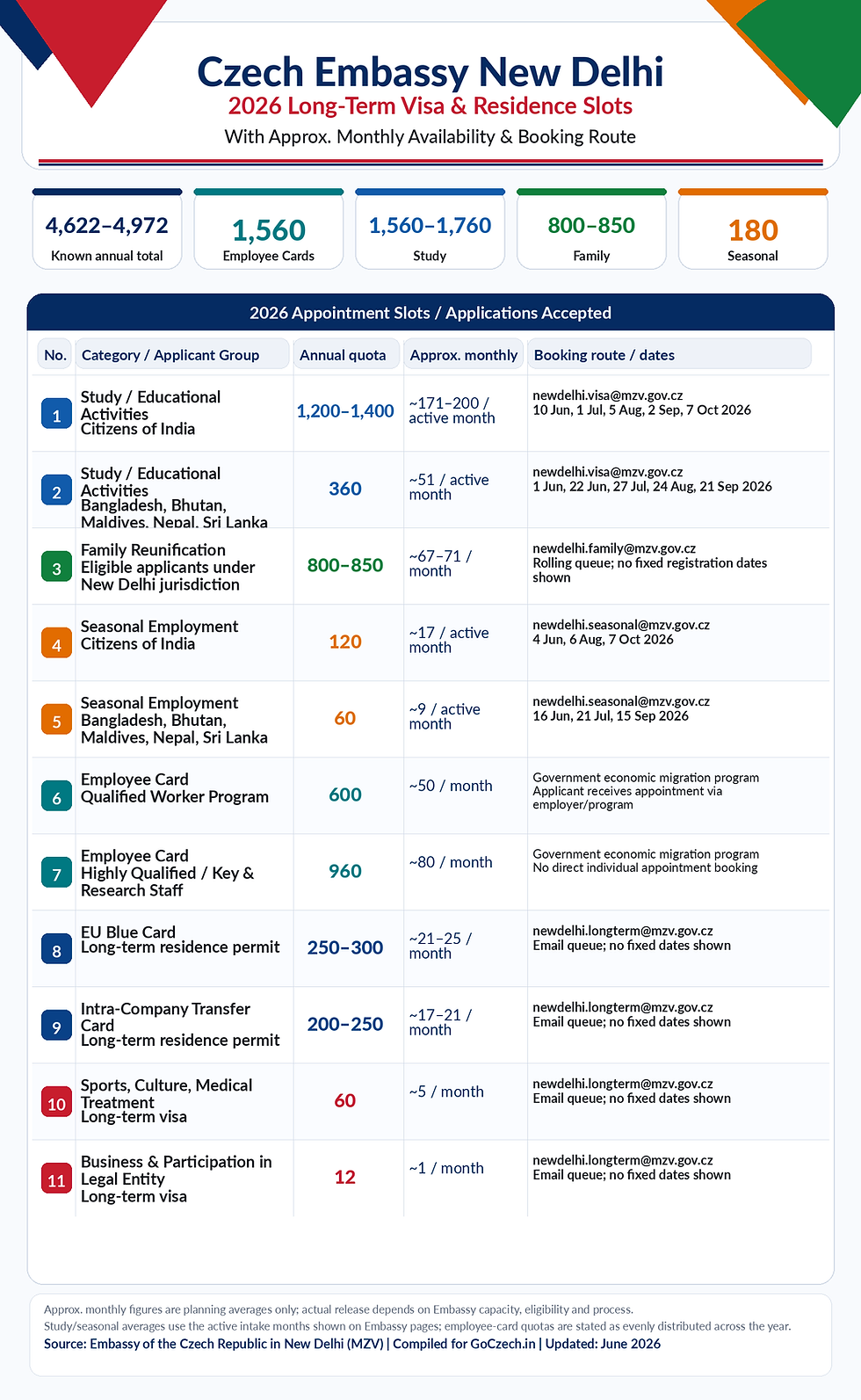
For 2026, the Embassy publishes the following capacities:
1,560 Employee Card applications, of which:
600 are allocated to the Qualified Worker Programme
960 are shared between the Highly Qualified Worker Programme and the Key and Research Staff Programme
1,200 applications for study and educational activities specifically for Indian citizens
120 applications for seasonal employment specifically for Indian citizens
800–850 applications for family reunification
250–300 applications for EU Blue Cards
200–250 applications for Intra-Company Transfer Cards
60 applications for sports, culture, medical treatment and training
12 applications for business and participation in a legal entity
The study and seasonal-employment numbers are expressly published for Indian citizens. Some other categories, including family reunification, EU Blue Cards and intra-company transfers, apply more broadly to eligible applicants within the Embassy’s consular jurisdiction. They should not be described as exclusively Indian allocations.
The Embassy also confirms that the annual Employee Card quota is fixed and cannot be exceeded. It is distributed throughout the calendar year, and applications within the economic-migration programmes receive appointments through the relevant programme process. Czech Embassy in New Delhi—economic migration programmes and quotas
The wider figures show that mobility between India and Czechia includes students, family members, seasonal workers, highly qualified professionals, researchers and transferred employees. However, these separate routes do not solve the ordinary staffing needs of Indian restaurants.
Why the additional 960 places are not a substitute
The 960 Employee Card places outside the Qualified Worker allocation are shared between the Highly Qualified Worker Programme and the Key and Research Staff Programme.
The Highly Qualified Worker Programme generally covers occupations in the main CZ-ISCO classes 1–3. A restaurant manager or certain genuinely senior culinary specialists may potentially qualify, depending on their actual duties, education and correct occupational classification.
A job title alone is insufficient. Calling someone a “manager” or “executive chef” does not automatically make the position highly qualified.
These routes may be useful for large hotels, premium restaurants and genuinely senior appointments, but they are not designed as general recruitment channels for ordinary chefs, cooks and kitchen staff.
Where an EU Blue Card is involved, the applicable minimum gross salary from 1 May 2026 to 30 April 2027 is CZK 73,823 per month. Czech Ministry of Industry and Trade
Some employers can offer this salary for an executive appointment. It is not economically realistic for most small and medium-sized restaurants recruiting the operational employees needed for everyday service.
Consequently, the 960-place allocation does not remove the need to reconsider the much smaller 600-place Qualified Worker quota.
The Qualified Worker Programme is the relevant route
The Qualified Worker Programme covers newly recruited employees in the main CZ-ISCO classes 4–8, including many practical occupations in manufacturing and services.
An employer must generally:
Have operated in Czechia for at least two years
Have no outstanding tax, social-security or health-insurance liabilities
Employ at least six people for at least three consecutive months
Offer lawful employment meeting the programme requirements
Submit the prescribed documentation through an authorised programme guarantor
In 2026, the programme requires a minimum gross monthly salary of CZK 27,328, equal to 1.22 times the statutory minimum wage. Official 2026 salary criterion
This makes the programme relevant to skilled chefs, cooks and other restaurant employees whose remuneration is around or above CZK 30,000 gross per month.
However, CZK 30,000 should not be treated as a ceiling or as a permanently sufficient salary. Remuneration should reflect experience, duties, working hours, the cost of living and prevailing conditions in the Czech labour market.
The 2027 salary increase adds urgency
The Czech government has decided that the statutory minimum wage will rise from CZK 22,400 to CZK 24,900 per month from 1 January 2027. Government of the Czech Republic
If the Qualified Worker Programme continues using the existing multiplier of 1.22, the salary criterion would mathematically become:
CZK 24,900 × 1.22 = CZK 30,378 gross per month
The competent authority must still publish the official programme criterion for 2027. The calculation should therefore be understood as a projection, not a confirmed programme threshold.
Nevertheless, employers should prepare for the likelihood that qualifying salaries will move above CZK 30,000.
Restaurants would then be required to pay higher wages while continuing to compete for only 600 Qualified Worker places. Those places are shared across eligible occupations and industries and are not reserved for hospitality. The number effectively available to restaurants may therefore be considerably smaller.
More than 12,000 Indian citizens already live in Czechia
The Indian community in Czechia is already substantial.
According to the Czech Ministry of the Interior’s July residence statistics, 12,305 Indian citizens had registered permitted residence in Czechia as of 31 July 2026. This included:
10,324 temporary residents
1,979 permanent residents
2 persons under temporary protection
The figures are available through the Ministry of the Interior’s 2026 residence-statistics page.
This is a snapshot of the legally resident population, not the number of Indians who arrived during 2026. The table also does not distinguish between students, employees, entrepreneurs and family members or identify their occupations.
It therefore cannot prove how many Indians work in restaurants, delivery services or passenger transport.
It is reasonable, however, to recognise a normal labour-market reality: as residents gain local experience and become better integrated, some seek higher-paying or more flexible employment. Restaurants cannot assume that chefs and kitchen workers already living in Czechia will remain permanently available for relatively demanding jobs unless salaries and working conditions are competitive.
The potential connection with Indian tourism
A stronger network of authentic Indian restaurants could complement Czechia’s efforts to attract more Indian visitors.
Prague’s architecture, history and culture will remain the principal reasons tourists choose the destination. Indian restaurants alone will not produce tourism growth. Nevertheless, reliable access to familiar food can improve the experience of Indian families, older visitors, vegetarians, conference delegates and organised tour groups.
Well-run Indian restaurants can:
Serve individual tourists and tour groups
Support hotels without specialist Indian kitchens
Cater for conferences, weddings and corporate events
Increase the confidence of Indian tour operators
Create employment and demand for Czech suppliers
Contribute to the cultural diversity of Czech cities
This should be understood as a supportive factor in tourism development, not as a guarantee that a higher employment quota will directly increase visitor numbers.
A responsible path towards a higher quota
Increasing the quota does not require Czechia to weaken immigration controls or employment standards.
A balanced reform could:
Increase the Qualified Worker allocation from 600 to at least 1,500.
Review demand, approval rates and employer compliance after a time period.
Consider a further increase to 3,000 or 5,000 if supported by genuine vacancies.
Continue requiring employers to prove financial and legal compliance.
Require fair remuneration reflecting qualifications, experience and working conditions.
Monitor recruiters and intermediaries to prevent excessive fees, misleading promises and worker exploitation.
Penalise employers or agencies that misuse the programme.
Consider demonstrated shortages in hospitality and other essential industries when allocating capacity.
The quota would remain fixed, regulated and distributed throughout the year. Each application would still be examined individually, and admission to a government programme would not guarantee approval of an Employee Card.
Conclusion
The Embassy’s published figures present a broader picture than the 600-place quota alone. New Delhi has 1,560 annual Employee Card places, but only 600 are available through the route most relevant to regular skilled chefs, cooks and restaurant workers.
The remaining 960 places serve highly qualified, key or research personnel. Separate capacities exist for students, seasonal workers, families, Blue Card applicants and other purposes, but these cannot be treated as substitutes for restaurant recruitment.
Meanwhile, more than 12,000 Indian citizens already live legally in Czechia, and Indian–Czech mobility is developing through education, employment, business and family connections.
As the programme salary threshold rises, Czech restaurants will need to offer increasingly competitive remuneration. Employers that satisfy all legal requirements should have a realistic opportunity to recruit appropriately skilled workers when they cannot find them locally.
A gradual increase in the Indian Qualified Worker allocation would not create an open-door system. It would allow an existing controlled programme to operate at a scale more consistent with the needs of Czech employers, the availability of skilled Indian workers and the future potential of Indian tourism.
The central policy question is therefore:
Is an annual Qualified Worker allocation of 600 applications sufficient—or should it be increased?
Commentary by Vijay Bakshi, Director of ADAMEK CONSULTANT and founder of GoCzech.in
Vijay Bakshi is a Czech–Indian immigration and business consultant based in Prague. Through ADAMEK CONSULTANT and GoCzech.in, he works with foreign nationals and Czech employers on immigration, documentation and integration matters. This article is intended to encourage an informed public discussion about lawful recruitment, fair working conditions and Czech–Indian economic cooperation. The opinions expressed in this article are his personal professional views.
Disclaimer: This article provides general information and policy commentary, not legal advice. Programme rules, salaries, occupational classifications, embassy capacities and government quotas may change. The published figures concern different legal categories and should not be combined into one India-only quota. Employers and applicants should verify the current requirements with the relevant Czech authorities or an authorised programme guarantor.

Comments