
Czech Embassy New Delhi 2026 Visa Appointment Slots: A More Open System, But Still Quota-Based
Updated: Jun 20
Many applicants from India and South Asia often complain that “the Czech Embassy does not give visa appointments” or that only getting a Czech long-term visa slot is almost impossible.
The reality from 2026 is more balanced.
The system is still strict, quota-based and rule-driven, but the Czech Government and the Embassy have now published clearer numbers for several categories, including:
study,
family reunification,
seasonal employment,
employee cards,
EU Blue Cards,
ICT cards and other long-term visa purposes.
The Embassy also confirms that long-term visa, long-term residence and employee card applicants must generally submit applications personally at the Embassy in New Delhi, which covers India, Bangladesh, Bhutan, Nepal, Sri Lanka and the Maldives, subject to jurisdiction and residence rules.
Planning to study, work seasonally, or reunite with family in the Czech Republic in 2026?
If you are applying through the Embassy of the Czech Republic in New Delhi, getting a visa appointment is one of the most important steps.”
This guide explains the latest Czech visa slots 2026 quota system for applicants applying through the Embassy of the Czech Republic in New Delhi, including study, family reunification, seasonal employment and employee card categories.
Why This Matters for Indian Applicants
The demand for Czech visas from India has grown significantly over the years. According to records published by the Immigration Police of the Czech Republic, as of 31 January 2007,
a total of 741 Indian citizens were registered as staying in the Czech Republic.
Out of them,
201 Indian citizens held permanent residence permits,
540 under long-term visa or residence categories.
This historical figure shows how small the Indian community in the Czech Republic was at that time compared with the growing number of students, workers, family members, entrepreneurs and professionals applying today. By 2026, the Czech Embassy in New Delhi has published a much more structured appointment and quota system, which reflects the increasing demand from India and South Asia.
For this reason, applicants should not treat Czech visa appointments casually. Correct timing, correct email format, proper documentation and choosing the right visa category have become extremely important.
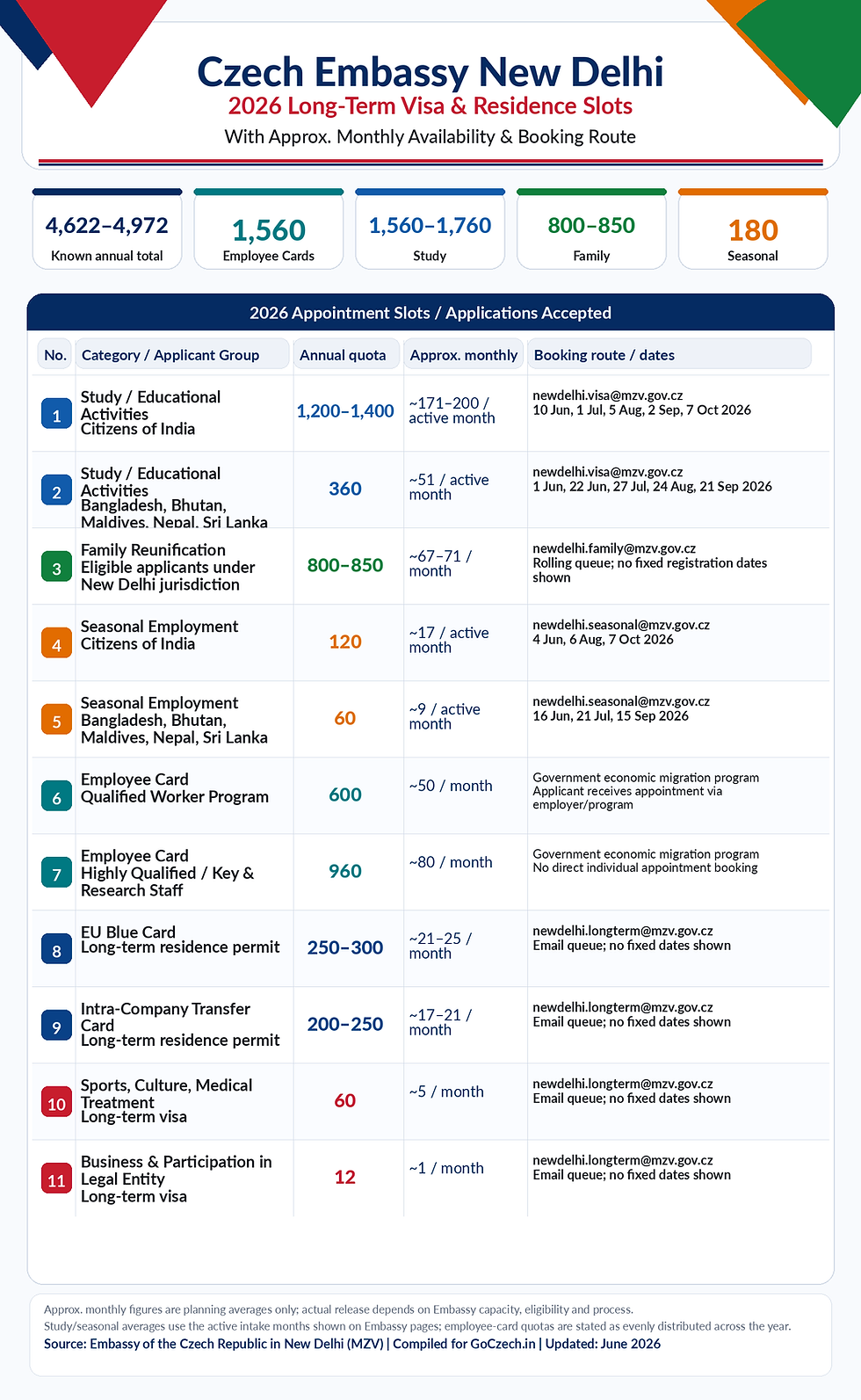
The Big Picture: Around 4,622–4,972 Application Slots in 2026
Based on the published numbers, the known 2026 intake across the categories below comes to approximately 4,622–4,972 applications / appointment opportunities. This does not mean guaranteed visa approval. It means the approximate number of applications the Embassy may accept under these categories, subject to eligibility, correct documentation, correct email format, quota availability and Embassy procedure.
Source update note:
The latest published figures and booking rules used in this article are based on updates published by the Embassy of the Czech Republic in New Delhi around 23 May 2026. Some related pages were further updated on 24 May 2026 and 1 June 2026, depending on the visa category. Applicants should always re-check the official Embassy website before sending a registration email.
Czech Visa Slots 2026: Category-Wise Quota Breakdown
Category | 2026 quota / applications accepted | Approx. monthly average |
Study / Educational Activities – India | 1,200–1,400 | approx. 171–200 per active intake month |
Study / Educational Activities – Bangladesh, Bhutan, Maldives, Nepal, Sri Lanka | 360 | approx. 51 per active intake month |
Family Reunification | 800–850 | approx. 67–71 per month |
Seasonal Employment – India | 120 | approx. 17 per active intake month |
Seasonal Employment – Bangladesh, Bhutan, Maldives, Nepal, Sri Lanka | 60 | approx. 9 per active intake month |
Employee Card – Qualified Worker Program | 600 | approx. 50 per month |
Employee Card – Highly Qualified / Key & Research Staff | 960 | approx. 80 per month |
Long-term residence permit – EU Blue Card | 250–300 | approx. 21–25 per month |
Long-term residence permit – Intra-Company Transfer Card | 200–250 | approx. 17–21 per month |
Long-term visa – sports, culture, medical treatment | 60 | approx. 5 per month |
Long-term visa – business and participation in a legal entity | 12 | approx. 1 per month |
The study quota for Indian citizens is published as 1,200–1,400 applications, with specific registration dates from June to October 2026. For Bangladesh, Bhutan, Maldives, Nepal and Sri Lanka, the study quota is 360 applications.
Study and Educational Activities: Important 2026 Email Dates
For Indian citizens, the Embassy has announced registration windows for study applications on:
10 June 2026,
1 July 2026,
5 August 2026,
2 September 2026 and
7 October 2026,
The timing is from 11:00 to 17:00 Indian time.
The October date covers October, November and December 2026.
The request email for study and educational activities is: newdelhi.visa@mzv.gov.cz.
For applicants from Bangladesh, Bhutan, Maldives, Nepal and Sri Lanka, the announced study registration dates are:
1 June 2026,
22 June 2026,
27 July 2026,
24 August 2026 and
21 September 2026,
from 11:00 to 17:00 Indian time.
The same email address, newdelhi.visa@mzv.gov.cz, is used.
A very important point: for study and seasonal employment categories, the Embassy states that the email registration is processed electronically with a randomized element. Applicants should not send multiple emails, should not use bots, and should follow the exact format, otherwise the email can be excluded.
Family Reunification: 800–850 Applications in 2026
For family reunification, the published 2026 number is 800–850 applications.
The request email is
Unlike study and seasonal employment, the Embassy page does not show fixed registration dates for family reunification. Emails are placed in a queue according to the order in which they are received.
This is an important opportunity for spouses, minor children and other eligible family members, but the email must be correctly formatted and must include the required PDF attachments, including proof of purpose of stay and the visa or residence permit of the person in the Czech Republic.
Seasonal Employment: India and Other South Asian Countries
For Indian citizens, the 2026 quota for seasonal employment is 120 applications.
The announced registration dates are
4 June 2026,
6 August 2026 and
7 October 2026,
each from 11:00 to 17:00 Indian time, using newdelhi.seasonal@mzv.gov.cz.
For Bangladesh, Bhutan, Maldives, Nepal and Sri Lanka, the 2026 seasonal employment quota is 60 applications.
The announced registration dates are
16 June 2026,
21 July 2026 and
15 September 2026,
again through newdelhi.seasonal@mzv.gov.cz.
Employee Cards: 1,560 Applications in 2026
This is one of the most important changes for workers and Czech employers.
The Embassy’s economic migration page says that from 1 July 2025, the Embassy accepts 1,560 employee card applications annually:
600 under the Qualified Worker Program and
960 under the Highly Qualified Worker Program or Key and Research Staff Program.
The same page also states that no employee card application can be submitted outside these programs.
This means individual applicants generally cannot simply email the Embassy and ask for an employee card appointment. The Embassy’s employee card page states that employee card applications can be submitted only within governmental economic migration programs and that individual applicants cannot apply for an appointment directly.
For employers and job seekers, the practical message is simple: the Czech employer must normally go through the relevant government economic migration program, and the applicant receives the appointment through that process.
EU Blue Card, ICT Card, Sports, Culture, Medical Treatment and Business
For other long-term residence and visa purposes, the Embassy has published the following 2026 numbers:
EU Blue Card: 250–300 applications
Intra-Company Transfer Card: 200–250 applications
Sports, culture, medical treatment: 60 applications
Business and participation in a legal entity: 12 applications
For these categories, the email address is newdelhi.longterm@mzv.gov.cz.
The Embassy page says that emails are placed in the queue according to the order received, and no fixed registration dates are shown on that page.
What Applicants Must Be Careful About
The most common mistake is sending the email in the wrong format.
For study and seasonal categories,
the subject line should contain only the passport number.
For long-term categories such as EU Blue Card, ICT, sports, culture, medical treatment and business, the subject line should include the full name, type of visa, purpose of stay and passport number, as stated by the Embassy.
Applicants should also remember these practical rules:
Do not send multiple emails for the same applicant.
Do not send emails before or after the official registration window.
Keep attachments in PDF format and below the stated size limit.
Do not use bots, scripts or automated email tools.
The Embassy warns that suspicious or automated mass-distribution emails may be excluded because of cybersecurity protection.
Conclusion: More Opportunities, But No Shortcut
The 2026 system shows that there are real appointment opportunities in many categories.
Compared with the common belief that “no visas are being given,” the published quotas show a more structured and relatively more open approach.
At the same time, applicants must understand that these are not guaranteed visas. They are application intake numbers.
For a successful Czech visa or residence application, the applicant must choose
the correct category,
prepare the correct documents,
follow the exact Embassy email format and
respect the official timing.
A small mistake in the subject line, attachment format or number of emails can result in exclusion.
For applicants from India and South Asia, understanding the Czech visa slots 2026 system is important before preparing documents or sending any registration email.
Need Professional Support?
At GoCzech.in, we have been assisting clients with Czech visa, documentation, translation and application-related support since 2005.
Our office has been established at Bhikaji Cama Place, New Delhi, since October 2006, and over the last two decades we have closely followed various changes in the Czech Embassy appointment and visa application system.
With this long practical experience, we understand how important correct documentation, proper timing and accurate email registration are for Czech long-term visa and residence applications.
GoCzech.in can help applicants and employers understand the correct Czech visa category, prepare documentation and avoid common mistakes before sending appointment requests.
How GoCzech.in May Assist
GoCzech.in may assist with:
identifying the correct Czech visa or residence category,
preparing a document checklist,
reviewing Embassy appointment email format,
checking whether documents are complete before registration,
certified Czech translation support,
Indian Apostille support,
guidance for study visa documentation,
family reunification documentation support,
seasonal employment documentation guidance,
Employee Card process explanation for applicants and employers,
EU Blue Card and long-term residence documentation guidance,
post-approval and pre-departure guidance,
communication support in English, Hindi, Bengali and Czech.
Contact
For professional assistance, you may contact:
Email: info@goczech.in
Disclaimer
This article is for general information only and does not guarantee appointment allocation, visa acceptance or visa approval. Embassy procedures, quotas, email rules and government regulations may change. Applicants should always check the latest official instructions from the Embassy of the Czech Republic in New Delhi before sending any appointment request or preparing a visa application.


Comments